Antioxidant and Neuroprotective Effects of Xanthohumol in an in Vitro Model of Parkinson’s Disease
DOI:
https://doi.org/10.66588/NCMR.v02i03.5Anahtar Kelimeler:
6-OHDA- Neuroblastoma- Parkinson's disease- Xanthohumol- SH-SY5Y cellsÖz
This study aimed to evaluate the neuroprotective effects of Xanthohumol (XAN), on Parkinson’s disease and an in vitro model by focusing on PPAR-γ and oxidative stress.
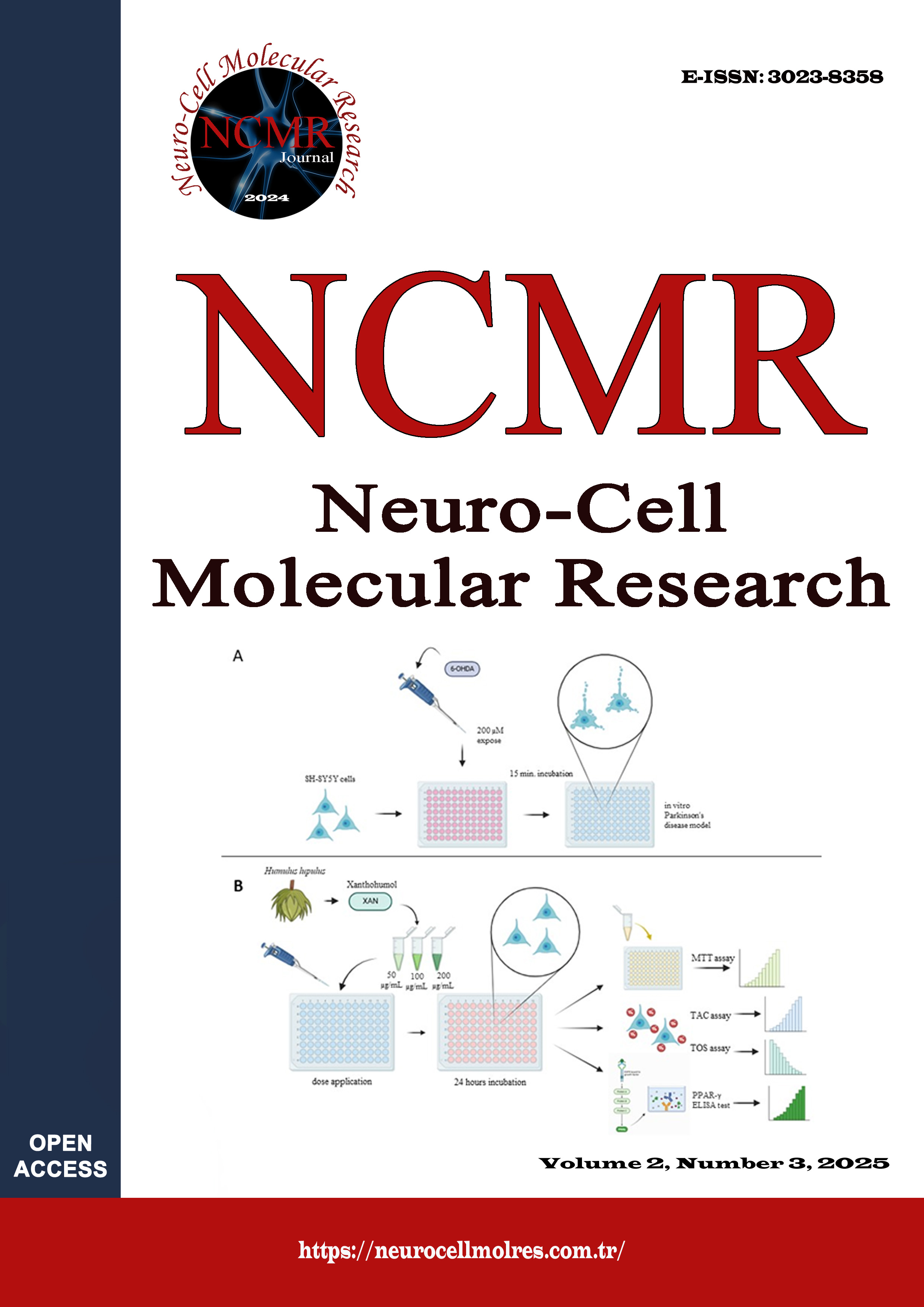
To establish a Parkinson's Disease (PD) model, SH-SY5Y cells were exposed to 200 µM 6-OHDA for 15 minutes. The SH-SY5Y cells were treated with different concentrations of XAN (50, 100, and 200 µg/mL). At the end of the experiment, cytotoxicity and Oxidative stress were assessed using the MTT assay, the total antioxidant capacity (TAC) and total oxidant status (TOS) assays, and the PPAR-γ assay.
These results suggest that specific doses of XAN may have neuroprotective effects with potential relevance for the treatment of neurodegenerative diseases. The Parkinson's control group shows a decrease in cell viability of up to 50% in SH-SY5Y cells compared with the control group. XAN prevented 6-OHDA-induced apoptosis and increased cell viability in a dose-dependent manner. TAC and TOS analyses showed that 100 and 200 µg/mL XAN more effectively increased TAC capacity by 60% but caused a 30% decrease in TOS. In contrast, elevated PPAR-γ levels were measured in correlation with the MTT result.
XAN results indicate that it may be part of the treatment strategy for Parkinson's disease.
İndirmeler
Referanslar
Pringsheim T, Jette N, Frolkis A and Steeves, TD. The prevalence of Parkinson's disease: a systematic review and meta‐analysis. Mov Disord. 2014;29(13):1583-1590. https://doi.org/10.1002/mds.25945
Pereira GM, Teixeira-dos-Santos D, Soares NM, Marconi GA, Friedrich DC, Saffie Awad P. et al. A systematic review and meta-analysis of the prevalence of Parkinson’s disease in lower to upper-middle-income countries. npj Parkinsons Dis. 2024;10(1):181. https://doi.org/10.1038/s41531-024-00779-y
Jankovic J., Parkinson’s disease: clinical features and diagnosis. J Neurol Neurosurg Psychiatry, 2008;79(4):368-376. https://doi.org/10.1136/jnnp.2007.131045
De Lau LM. and Breteler MM, Epidemiology of Parkinson's disease. Lancet Neurol. 2006;5(6):525-535. https://doi.org/10.1016/S1474-4422(06)70471-9
Lang AE, and Lozano AM, Medical Progress: Parkinson's Disease First of Two Parts. N Engl J Med. 1998;339(15):1044-1053. https://doi.org/10.1056/NEJM199810083391506
Yayınlanmış
Sayı
Bölüm
Kategoriler
Nasıl Atıf Yapılır