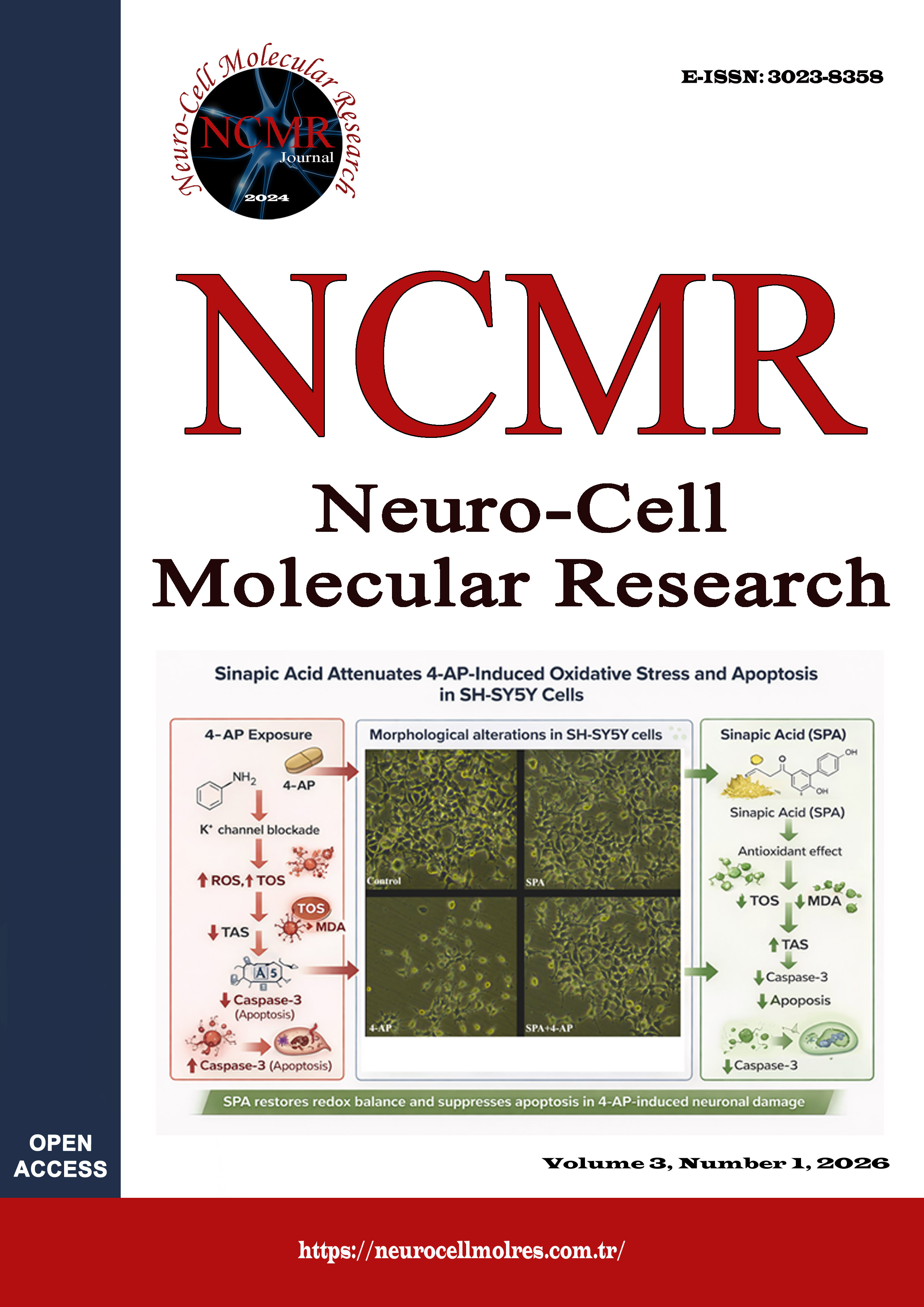
The Effect of Sinapic Acid on Oxidative Stress and Apoptosis in 4-Aminopyridine-Induced Neuronal Damage
DOI:
https://doi.org/10.66588/NCMR.v3i1.3Keywords:
SH-SY5Y cells, 4-aminopyridine, Sinapic acid, Oxidative stress, ApoptosisAbstract
Neuronal damage, which is responsible for the development and progression of many neurological disorders, is closely linked to cellular-level mechanisms, primarily oxidative stress and apoptosis. Oxidative stress, particularly that resulting from the overproduction of reactive oxygen species (ROS), induces biochemical alterations such as lipid peroxidation, protein oxidation and DNA damage. These biochemical changes disrupt neuronal cell integrity and alter cellular functions. This process leads to the activation of intrinsic apoptotic pathways, mitochondrial dysfunction, and programmed cell death.
4-aminopyridine (4-AP) is a potassium channel blocker widely used to induce oxidative damage resulting from excessive neuronal stimulation and is commonly used in experimental neurotoxicity models.
The aim of this study is to investigate the effect of sinapic acid (SPA), a naturally occurring phenolic compound with strong antioxidant properties, on 4-AP-induced neuronal damage in human neuroblastoma cells (SH-SY5Y). In the experimental design, cells were divided into four categories: control, SPA, 4-AP, and SPA + 4-AP. In addition to total antioxidant status (TAS), total oxidant status (TOS), and malondialdehyde (MDA) levels, caspase-3 activity—a hallmark marker of apoptosis, was evaluated. According to our findings, 4-AP application led to a significant decrease in TAS levels but increased TOS, MDA, and caspase-3 levels. This suggests that 4-AP application increases oxidative stress and apoptosis in SH-SY5Y cells. In contrast, SPA pre-treatment significantly increased TAS levels and decreased TOS, MDA, and caspase-3 levels compared to the 4-AP group.
In conclusion, SPA was shown to significantly modulate oxidative stress and apoptotic processes, thereby mitigating 4-AP-induced neuronal damage. These findings have strengthened the potential of SPA as a neuroprotective agent in oxidative stress-induced neuronal damage.
Downloads
References
Emerit J, Edeas M, Bricaire F. Neurodegenerative diseases and oxidative stress. Biomed Pharmacother. 2004;58(1):39–46. https://doi.org/10.1016/j.biopha.2003.11.004
He L, He T, Farrar S, Ji L, Liu T, Ma X. Antioxidants maintain cellular redox homeostasis by elimination of reactive oxygen species. Cell Physiol Biochem. 2017;44(2):532–553. https://doi.org/-10.1159/000485089
Dong XX, Wang Y, Qin ZH. Molecular mechanisms of excitotoxicity and their relevance to pathogenesis of neurodegenerative diseases. Acta Pharmacol Sin. 2009;30(4):379–387. https://doi.org/-10.1038/aps.2009.24
Yıldızhan K, Nazıroğlu M. NMDA receptor activation stimulates hypoxia-induced TRPM2 channel activation, mitochondrial oxidative stress, and apoptosis in neuronal cell line: modular role of memantine. Brain Res. 2023;1803:148232. https://doi.org/10.1016/j.-brainres.2023.148232
Affrald RJ, Narayan S. Exploring the versatility of 4-aminopyridine and its analogues in managing demyelinating diseases. Russ J Bioorg Chem. 2024;50(3):824–854. https://doi.org/10.1134/S1068162024030270
Lu CW, Lin TY, Hsieh PW, Chiu KM, Lee MY, Wang SJ. Cynarin inhibits exocytotic glutamate release from rat cortical nerve terminals. Neurochem Int. 2023;167:105537. https://doi.org/10.1016/j.-neuint.2023.105537
Yıldızhan K, Huyut Z, Altındağ F, Bayir MH. The role of oxidative stress, apoptosis and altered TRPM2 channel activation in doxorubicin-induced liver injury; the protective effect of selenium. Acta Med Alanya. 2024;8(2):118–124. https://doi.org/10.30565/medalanya.1483307
Papagiouvannis G, Theodosis-Nobelos P, Rekka EA. Trolox, ferulic, sinapic, and cinnamic acid derivatives with antioxidant properties. Molecules. 2024;29(16):3763. https://doi.org/10.3390/-molecules29163763
Farzan M, Abedi B, Bhia I, Madanipour A, Farzan M, Bhia M, et al. Pharmacological activities and molecular mechanisms of sinapic acid in neurological disorders. ACS Chem Neurosci. 2024;15(16):2966–2981. https://doi.org/10.1021/acschemneuro.4c00349
Altındağ F, Bayır MH, Alhalboosi JKI, Yıldızhan K. Syringic acid mitigates scopolamine-induced cognitive impairment by regulating PSD-95 and GSK-3β and by preventing neurodegeneration in an Alzheimer-like rat model. Exp Neurol. 2025;115556. https://doi.org/10.1016/j.expneurol.2025.115556
Tungalag T, Yang DK. inapic acid protects SH-SY5Y human neuroblastoma cells against 6-hydroxydopamine-induced neurotoxicity. Biomedicines. 2021;9(3):295. https://doi.org/10.3390/-biomedicines9030295
Taşkıran A, Topçu A. Investigation of the protective role of quercetin on oxidative stress and endoplasmic stress pathway in 4-aminopyridine-induced neuronal damage. Turk J Agric Food Sci Technol. 2023;11(S1):2505–2511. https://doi.org/10.24925/turjaf.v11is1.2505-2511.6413
Soares DC, Portela JL, Roos DH, Rodrigues NR, Gomes KK, Macedo GE, et al. Treatment with pentylenetetrazole (PTZ) and 4-aminopyridine (4-AP) differently affects survival, locomotor activity, and biochemical markers in Drosophila melanogaster. Mol Cell Biochem. 2018;442(1):129–142. https://doi.org/10.1007/s11010-017-3198-3
Wang XQ, Xiao AY, Yang A, LaRose L, Wei L, Yu SP. Block of Na+, K+-ATPase and induction of hybrid death by 4-aminopyridine in cultured cortical neurons. J Pharmacol Exp Ther. 2003;305(2):502–506. https://doi.org/10.1124/jpet.102.045013
Singh, A., Kukreti, R., Saso, L., & Kukreti, S. Oxidative stress: a key modulator in neurodegenerative diseases. Molecules. 2019;24(8):1583. https://doi.org/10.3390/molecules24081583
Chen X, Guo C, Kong J. Oxidative stress in neurodegenerative diseases. Neural Regen Res. 2012;7(5):376-85. https://doi.org/10.3969/j.issn.-1673-5374.2012.05.009
Łukawski K, Czuczwar SJ. Oxidative stress and neurodegeneration in animal models of seizures and epilepsy. Antioxidants. 2023;5;12(5):1049. https://doi.org/10.3390/antiox12051049
Shabani M, Jamali Z, Naserian A, Khezri S, Salimi AMaintenance of mitochondrial function by sinapic acid protects against tramadol-induced toxicity in isolated mitochondria obtained from rat brain. Naunyn Schmiedebergs Arch Pharmacol. 2024;397(2):889–897. https://doi.org/10.1007/s00210-023-02648-6
Ansari MA. Sinapic acid modulates Nrf2/HO-1 signaling pathway in cisplatin-induced nephrotoxicity in rats. Biomed Pharmacother. 2017;93:646–653. https://doi.org/10.1016/j.biopha.2017.06.085
Mansouri A, Reiner Ž, Ruscica M, Tedeschi-Reiner E, Radbakhsh S, Bagheri Ekta M, Sahebkar A. Antioxidant effects of statins by modulating Nrf2 and Nrf2/HO-1 signaling in different diseases. J Clin Med. 2022;11(5):1313. https://doi.org/10.3390/jcm11051313
Çınar R, Ahlatcı A. TRPM2 channel contribution to CdCI2-related neurotoxicity in SH-SY5Y cells: Protective role of selenium: Effect of Se in CdCI2-related neurotoxicity. Neuro-Cell Mol Res. 2024;1(2):40-46. https://doi.org/10.66588/NCMR.v01i02.2
Ahlatcı A, Yazğan Y, Yıldızhan K. The protective effect of chrysin against glutamate-induced oxidative stress and inflammation in SH-SY5Y cells. Kastamonu Med J. 2025;5(3):166–171. https://doi.org/10.51271/KMJ-0204
Yıldızhan K, Nazıroğlu M. Glutathione depletion and parkinsonian neurotoxin MPP+-induced TRPM2 channel activation play central roles in oxidative cytotoxicity and inflammation in microglia. Mol Neurobiol. 2020;57(8):3508–3525. https://doi.org/10.1007/s12035-020-01974-7
Wu Q, Guan YB, Zhang KJ, Li L, Zhou Y. Tanshinone IIA mediates protection from diabetes kidney disease by inhibiting oxidative stress induced pyroptosis. J Ethnopharmacol. 2023;316:116667. https://doi.org/10.1016/j.jep.2023.116667
Luft JG, Steffens L, Morás AM, da Rosa MS, Leipnitz G, Regner GG, et al. Rosmarinic acid improves oxidative stress parameters and mitochondrial respiratory chain activity following 4-aminopyridine and picrotoxin-induced seizure in mice. Naunyn Schmiedebergs Arch Pharmacol. 2019;392(11):1347–1358. https://doi.org/10.1007/s00210-019-01675-6
Sancheti J, Shaikh MF, Chaudhari R, Somani G, Patil S, Jain P, et al. Characterization of anticonvulsant and antiepileptogenic potential of thymol in various experimental models. Naunyn Schmiedebergs Arch Pharmacol. 2014;387(1):59–66. https://doi.org/10.1007/s00210-013-0917-5
Çiğ E, Yardımcı M, Çınar R, Yıldızhan K. Protective role of zingerone against high glucose-Induced retinal pigment epithelial cell damage through modulation of the TRPM2 channel pathway. Mol Biol Rep. 2026;53(1):309. https://doi.org/10.1007/s11033-026-11476-9
Prabhakar P, Ahmed BA, Chidambaram SB, Kumar A, Pandian A. In vitro ameliorative effects of sinapic acid on Parkinson related neurotoxicity in SHSY5Y cell lines. Int J Nutr Pharmacol Neurol Dis. 2023;13(1):16–24. https://doi.org/10.4103/ijnpnd.ijnpnd_67_22
Madireddy S, Madireddy S. Therapeutic strategies to ameliorate neuronal damage in epilepsy by regulating oxidative stress, mitochondrial dysfunction, and neuroinflammation. Brain Sci. 2023;13(5):784. https://doi.org/10.3390/brainsci13050784
Hung YC, Kuo YH, Hsieh PW, Hsieh TY, Kuo JR, Wang SJ. Chlorogenic acid decreases glutamate release from rat cortical nerve terminals by P/Q-Type Ca2+ channel suppression: A possible neuroprotective mechanism. Int J Mol Sci. 2021;22(21):11447. https://doi.org/10.3390/ijms222111447
Yıldızhan K. Protective role of selenium against bisphenol-A induced oxidative stress, cytokine generation and apoptosis in SH-SY5Y neuronal cell line. J Cell Neurosci Oxid Stress. 2020;12(3):955–962. https://doi.org/10.37212/jcnos.1005692
Genç S, Taghizadehghalehjoughi A, Nigde E, et al. Antioxidant and Neuroprotective Effects of Xanthohumol in an in Vitro Model of Parkinson’s Disease. Neuro-Cell Mol Res. 2025;2(3):95-101. https://doi.org/10.66588/NCMR.v02i03.5